AJ Alberts Plumbing and Water Conditioning Logo 651-738-0580
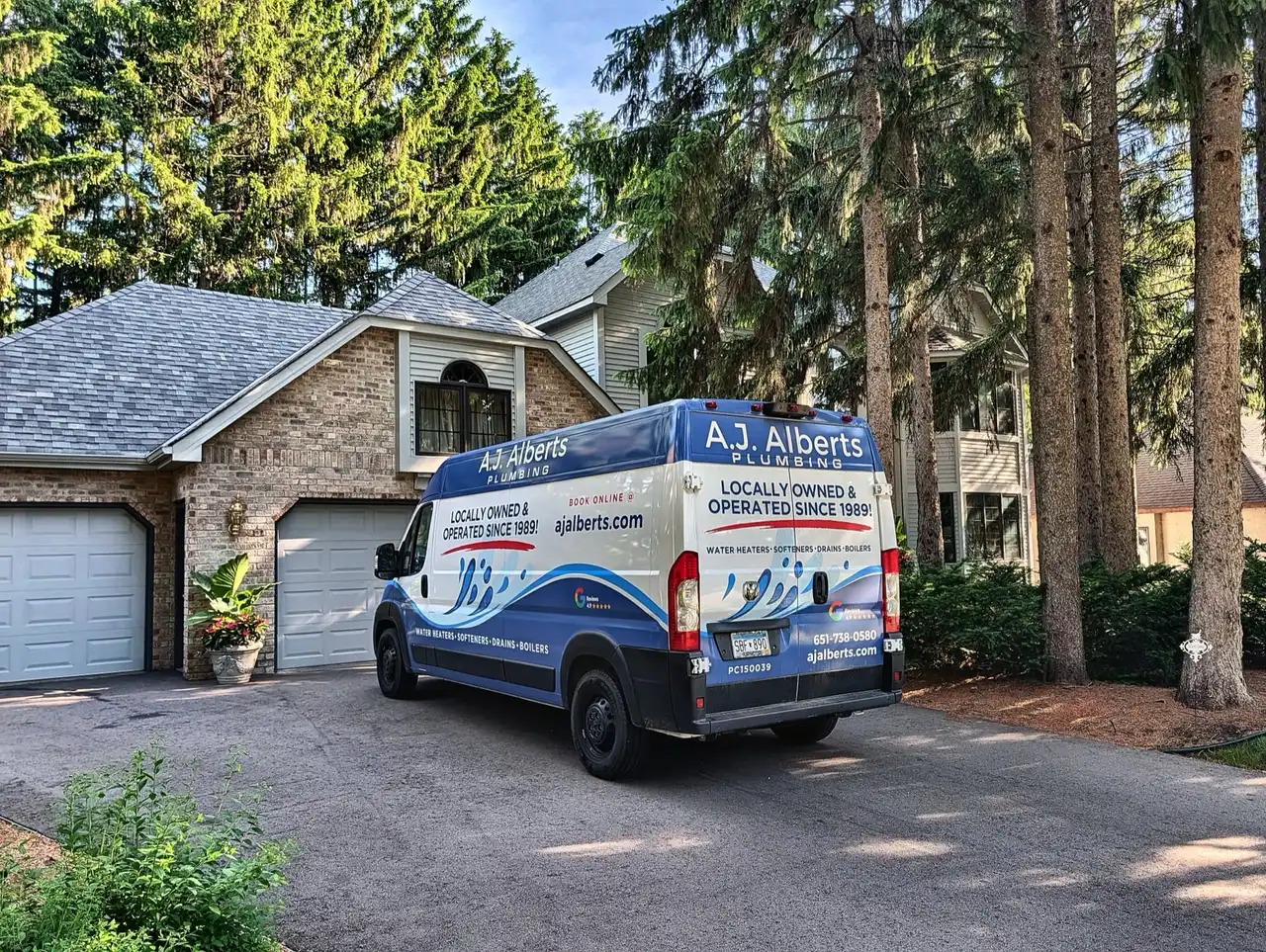
A.J. Alberts Plumbing service van at a Twin Cities home, locally owned and operated since 1989

Water Heaters

Tank vs Tankless Water Heater for Twin Cities Homes

When tankless makes sense, when it does not, and the Minnesota-specific factors that change the math. Honest comparison from an installer that does both.

Call 651-738-0580

For most Twin Cities homes planning to stay 5+ years, a properly sized condensing tankless water heater is the better long-term value than a tank unit. Lifespan is roughly double, energy use is 25-35% lower, and the basement flooding risk of tank failure is eliminated. The upfront cost is 2 to 3x higher than a comparable tank. The math favors tankless when you can stay long enough to recover the upfront difference through energy savings and avoided replacement.

The two options

Tank water heaters store 40 to 80 gallons of pre-heated water in an insulated tank. When you use hot water, cold water enters the tank and the burner reheats it. The tank reheats continuously to maintain temperature even when no one is using hot water (this is called standby loss).

Tankless water heaters (also called on-demand) have no storage tank. When you turn on a hot water fixture, the unit detects flow and rapidly heats water to setpoint as it passes through. No standby loss, no capacity limit, no flooding risk.

The math in the Twin Cities

FactorTankTankless
Installed cost (typical)$1,500 to $2,500$3,500 to $6,500
Lifespan (Twin Cities)8 to 12 years15 to 20 years
Energy efficiency factor0.60 to 0.700.85 to 0.95
Standby lossSignificantNone
Hot water capacityTank capacity limitContinuous
Failure modeTank rupture, basement floodComponent failure, no flood risk
Annual maintenanceRecommended flushRequired annual descale

Net cost-per-year over 15 years (rough estimate for typical Twin Cities home):

  • Tank: $2,000 installed plus 2 replacements over 30 years = $6,000 / 30 = $200/year capital plus $35/month energy = $620/year total
  • Tankless: $5,000 installed plus 1 replacement over 30 years = $7,000 / 30 = $233/year capital plus $25/month energy = $533/year total

Tankless wins by roughly $80 to $150 per year over a 30-year horizon. Less compelling over a 5-year horizon, more compelling over a 20-year horizon.

Why tankless wins for most Twin Cities homes

  1. No flood risk. Tank water heaters fail by tank rupture or supply leak, often dumping 40-80 gallons of water onto a basement floor. Tankless units fail by component, not by tank rupture, so no flood. For homeowners with finished basements or significant basement contents, this alone often justifies tankless.

  2. Continuous hot water. No capacity limit. A family of 5 can shower back-to-back without running out, which is a real-world quality-of-life win.

  3. Significantly lower energy use. Especially in Minnesota where water heating is a major portion of total home energy use. The 0.85 to 0.95 efficiency factor on modern tankless condensing units significantly beats tank’s 0.60 to 0.70.

  4. Longer lifespan. Cost per year of operation is lower over the asset lifetime.

  5. Smaller footprint. Wall-mounted tankless units free up basement floor space.

When tankless is NOT the right call

  • You are selling within 5 years. The energy savings will not recover the upfront cost in your timeframe.
  • Your gas supply is undersized. Tankless units have high BTU demand and may require an upgraded gas line. Factor that in.
  • Very hard water with no softener. Tankless units must be descaled annually in hard water. If you will not maintain it, a tank is more forgiving.
  • You have no current softener and will not install one. In 14-22 gpg Twin Cities water, tankless units scale fast without softener pre-treatment. Recommended setup: softener installed first, then tankless.
  • Cold-climate undersizing. A common mistake is installing a tankless rated for warm-climate temperatures. In Minnesota winters, incoming water is around 45 to 50 degrees, so the unit must do significantly more work. Sizing must reflect this.

The hybrid heat pump water heater option

A third category worth mentioning: hybrid heat pump water heaters. These use a small heat pump to extract heat from surrounding air, requiring much less electricity than a standard electric tank.

For homes with electric water heaters and basements that stay above 50 degrees year-round, hybrid heat pump units can deliver 60-70% energy savings versus standard electric. Worth considering in Minnesota for homeowners moving away from gas.

The right call for your home

Free in-home consultation from A.J. Alberts walks through:

  • Your current water heater age and condition
  • Your home’s hot water demand (number of bathrooms, simultaneous use patterns)
  • Gas line capacity and venting feasibility
  • Existing softener and water quality
  • Your planned tenure in the home

Then we recommend tank, tankless, or hybrid based on what fits your home, not based on what carries the largest margin.

Call 651-738-0580 or see water heaters.

Frequently Asked Questions

What is the lifespan of a tank vs tankless water heater?
Tank water heaters typically last 8 to 12 years in the Twin Cities (hard water shortens this without flushing). Tankless water heaters typically last 15 to 20 years with proper annual maintenance including descaling. So tankless lifespan is roughly double, which factors into the cost-per-year comparison.
Are tankless water heaters worth the upfront cost in Minnesota?
For most Twin Cities homes, yes if you plan to stay 5+ years. The math factors in: 25-35% lower energy use over the life of the unit (significant in Minnesota where water heating is a large portion of energy use), longer lifespan, continuous hot water rather than tank capacity limits, and no risk of tank failure flooding the basement. Upfront cost is 2 to 3x a comparable tank unit installed.
What size tankless water heater does a Twin Cities home need?
Sizing is measured in gallons per minute at a given temperature rise. In Minnesota, incoming water is around 45-50 degrees in winter, so the unit must heat water by 65-75 degrees to deliver 120 degree hot water. A typical 2-bath Twin Cities home needs a tankless unit rated for at least 8 GPM at 70 degree rise. Larger homes with simultaneous fixture use need higher capacity. Undersized tankless units perform poorly in Minnesota winters.

Need Help in the Twin Cities?

Free in-home water test. Written upfront pricing. Lifetime craftsmanship warranty.