Plumbing
Edina Plumbing in 1960s and 1970s Homes: What Owners Should Check
Learn what to inspect in an Edina home built in the 1960s or 1970s, from supply pipes and drains to service lines, permits, and valves. Call 651-738-0580.
For an Edina home built in the 1960s or 1970s, inspect the actual supply-pipe materials, shutoff valves, drain and sewer condition, water heater connections, fixture flow, and the property's service-line record. Age alone does not prove a house needs repiping. Widespread low flow, active leakage, repeated drain backups, visible deterioration, or unsafe installation details deserve prompt diagnosis.
Published October 28, 2026 by Steve Grohn, owner of A.J. Alberts.
Mid-century houses are a major part of Edina’s housing story. The city’s 2018 Comprehensive Plan reports that nearly 60 percent of structures were built from 1950 through 1979 and gives 1968 as the median construction year. That makes 1960s and 1970s plumbing questions common, but it does not make every house the same.
Some homes still have substantial original plumbing. Others have had a water heater, bath, kitchen, service line, or sections of supply and drain piping replaced at different times. A useful inspection starts with what is present now, not a broad assumption based on the year on the property record.
Why does the construction era matter in an Edina home?
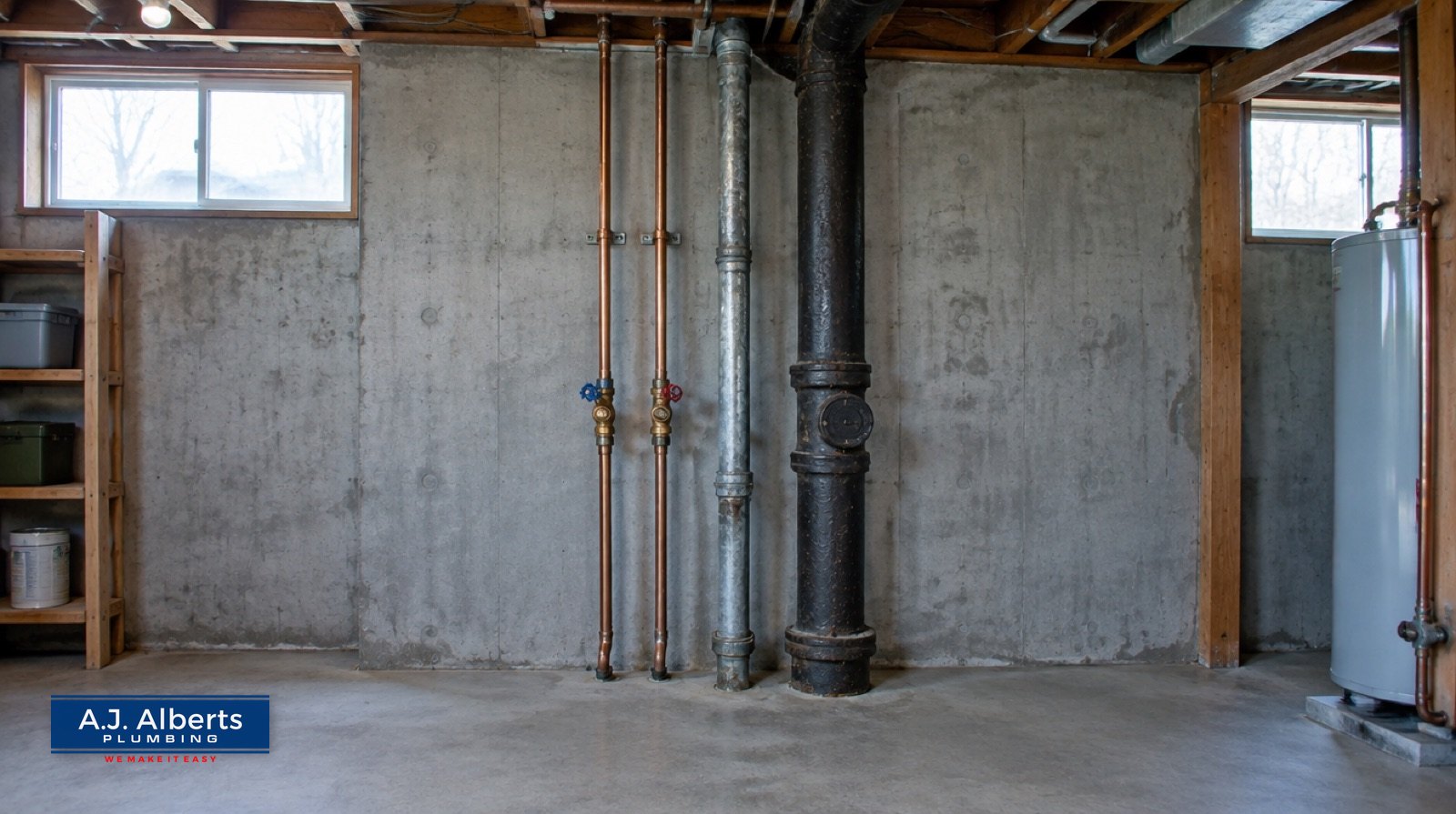
The construction year gives a plumber or buyer a starting point. Materials and installation practices changed over time, and a house can contain several generations of work. An exposed basement may show copper supply lines next to an older galvanized section, a cast-iron drain stack connected to newer plastic piping, or shutoff valves added during later remodeling.
Those transitions are not automatically defects. They are places to inspect closely because mixed systems can reveal the history of the house. The practical questions are whether the materials are approved and properly joined, whether flow and drainage are normal, whether valves operate, and whether there is evidence of leakage, restriction, or an improvised repair.
Start with this material-first review:
| Area | What to identify | What can justify faster action |
|---|---|---|
| Water supply piping | Galvanized steel, copper, plastic piping, and transitions between materials | Active leaks, widespread weak flow, visible deterioration, or repeated repairs |
| Main shutoff and branch valves | Location, accessibility, material, and whether the valve operates correctly | A valve that will not close, leaks when operated, or cannot be reached safely |
| Drain and vent piping | Cast iron, galvanized steel, copper, plastic, and visible connections | Recurring backups, sewer odor, active seepage, or several slow fixtures |
| Buried sewer line | Known material, repair history, symptoms, and available inspection records | A backup, repeated blockage, confirmed break, or significant deformation |
| Water heater connections | Age, venting or electrical connection, shutoff, discharge piping, and signs of leakage | Leaking tank, unsafe venting, damaged wiring, or an improperly terminated relief line |
| Fixtures | Flow, drainage, leakage, shutoffs, and evidence of earlier remodeling | Water damage, a fixture that will not drain, or a leak that cannot be isolated |
Which supply pipes should you look for?
Galvanized steel supply piping may still be present in an older house, even when visible sections near a remodeled room are copper or plastic. Internal corrosion can restrict a galvanized pipe without creating an obvious exterior leak. Possible clues include weak flow at several fixtures, discolored water after a period of nonuse, visible corrosion at threaded connections, and a history of spot repairs.
Those clues are not a complete diagnosis. A partly closed valve, debris at an aerator, a pressure problem, or a single failing fixture can also reduce flow. Compare hot and cold water, note whether the issue affects one fixture or several, and identify the pipe material before assuming a whole-house repipe is necessary.
Copper piping should also be inspected instead of treated as permanently trouble free. Look for active seepage, green or white deposits around fittings, damage from prior freezing, unsupported runs, and questionable transitions to other materials. Newer plastic piping can be a legitimate update, but its fittings, supports, protection, and connection method still matter.
If you are buying a house, the Twin Cities plumbing inspection guide explains how to turn those observations into useful questions before closing.
What does Edina’s service-line inventory tell you?
Edina’s Water Service Line Inventory reports an updated systemwide count of zero lead service lines, two galvanized lines requiring replacement, zero unknown lines, and all remaining lines classified as non-lead. The city also explains that it owns the portion from the water main to the curb stop, while the property owner owns the portion from the curb stop to the building.
That inventory is useful, but it has a boundary. It describes the service line category in the utility’s records. It does not identify every pipe, fitting, soldered joint, valve, or fixture inside a specific home. The city page notes that lead can enter water through household plumbing, which is why a service-line classification should not be presented as a laboratory result from a kitchen tap.
Look up the property record through the city’s inventory tool. If the record, exposed material, or renovation history is unclear, ask the city and a licensed plumber what part has been identified and what still needs confirmation.
What drain and sewer clues matter in a mature neighborhood?
An older cast-iron drain stack can remain in service, while a buried sewer line can have a different material and history. The material alone does not reveal the condition of the entire system. Pay attention to symptoms and patterns:
- One slow sink often points to a local fixture or branch issue.
- Several slow fixtures can indicate a larger drain restriction.
- A recurring basement backup deserves diagnosis beyond another temporary clearing.
- Sewer odor can involve a dry trap, failed seal, vent issue, or another source.
- Mature trees near the route of the sewer do not prove root intrusion, but recurring blockage can justify a camera inspection.
A camera inspection is most useful when it answers a defined question, such as the location of a repeated blockage, the condition of a repair, or the buried line’s role in a purchase decision. The recording and technician’s observations should distinguish deposits, roots, offsets, cracks, bellies, and other conditions instead of treating every image as a replacement recommendation. Our drain cleaning and sewer service page describes the diagnostic options used for recurring problems.
When should you repair one area versus plan broader work?
The right scope follows the evidence. One leaking valve does not prove that all supply piping has failed. Repeated leaks across several original sections, widespread restriction, or incompatible prior work can make a broader plan more sensible than another isolated repair.
Use three priority levels:
- Address now: Active leakage, sewage backup, a shutoff that cannot isolate a leak, unsafe water-heater venting or wiring, or a confirmed failed pipe needs prompt attention.
- Plan and budget: Repeated failures, widespread low flow tied to internal restriction, several failing valves, or a camera-confirmed sewer defect may justify coordinated replacement.
- Monitor: Stable piping with normal flow, no leakage, no recurring drainage symptoms, and serviceable valves may need documentation and periodic review rather than immediate replacement.
The common mistake is choosing a scope before identifying the failure. A focused repair can be the right answer when the problem is isolated and the remaining system is serviceable. A larger project can be more practical when the same material and failure pattern appear throughout the house.
Do plumbing projects in Edina require permits?
The City of Edina’s Building Inspections page says a plumbing permit is required for installation, alteration, repair, or extension of plumbing systems, including many fixture, water-heater, and water-softener replacements. Work that connects, disconnects, modifies, or repairs a water or sewer service may require a separate sewer and water permit.
Permit requirements depend on the exact scope. Confirm the permit and inspection sequence with the city before work begins. Minnesota’s plumbing code also applies current requirements to new work in an existing building while allowing maintained existing systems to remain when they are not being altered and were compliant when installed. That distinction is another reason not to label every older component a violation solely because of its age.
How does Edina water affect older fixtures and piping?
Edina operates separate Edina and Morningside water systems. The city’s water and sewer guidance reports that the main Edina system is approximately 17 to 20 grains per gallon of hardness and recommends a softener setting that produces 3 to 4 grains per gallon. A small portion of Morningside receives treated Minneapolis water and does not need additional softening. Confirm the supplier and actual household hardness before changing settings or equipment.
Hard water can contribute to scale on fixtures and inside water-using equipment, but hardness does not diagnose a corroded pipe, sewer restriction, or lead concern. Keep those questions separate. A.J. Alberts’ free basic in-home water test checks hardness, iron, chlorine, pH, total dissolved solids, and alkalinity, plus nitrate for private-well customers. It does not test for lead, PFAS, every regulated contaminant, or overall drinking-water safety.
Related reading for Edina homeowners
- Plumbing and Water Softeners in Edina, MN
- Water Heater Replacement in Edina
- Drain Cleaning in Edina
- Plumbing Inspection Checklist for Twin Cities Home Buyers and Sellers
- Common Plumbing Problems in Twin Cities Homes
Sources and Further Reading
- City of Edina, 2018 Comprehensive Plan
- City of Edina, Water Service Line Inventory
- City of Edina, Building Inspections and permit guidance
- Minnesota Plumbing Code, Chapter 4714
The Bottom Line: Inspect the System That Is Actually in the House
An Edina home from the 1960s or 1970s deserves a careful, material-specific review, not an automatic repipe recommendation. Identify the supply and drain materials, test fixture flow, locate and operate the main shutoff, document visible transitions, check the water-heater connections, review the city’s service-line record, and investigate recurring sewer symptoms with the right diagnostic tool.
Move quickly when there is active leakage, sewage backup, an inoperable shutoff, an unsafe installation, or a confirmed failed line. Plan broader work when the same failure pattern appears across the system. If the plumbing is stable and working correctly, document it and monitor it instead of replacing it simply because of the construction year.
Steve Grohn, owner of A.J. Alberts, has served Twin Cities homeowners through the Woodbury-based plumbing and water-conditioning company since 1996. A.J. Alberts is locally owned and operated, and recommendations are made without commissioned salespeople.
Want a licensed plumber to help identify what is original, what has been updated, and what actually needs attention? Call A.J. Alberts at 651-738-0580. Minnesota plumbing license PC150039.
Frequently Asked Questions
Do all Edina homes from the 1960s and 1970s need repiping?
Does Edina's water service line inventory cover pipes inside my home?
What are warning signs of aging galvanized water pipes?
When is a sewer camera inspection useful in an older Edina home?
Do plumbing repairs in Edina require a permit?
Related services
Need Help in the Twin Cities?
Free in-home water test. Written upfront pricing. Lifetime craftsmanship warranty.