AJ Alberts Plumbing and Water Conditioning Logo 651-738-0580
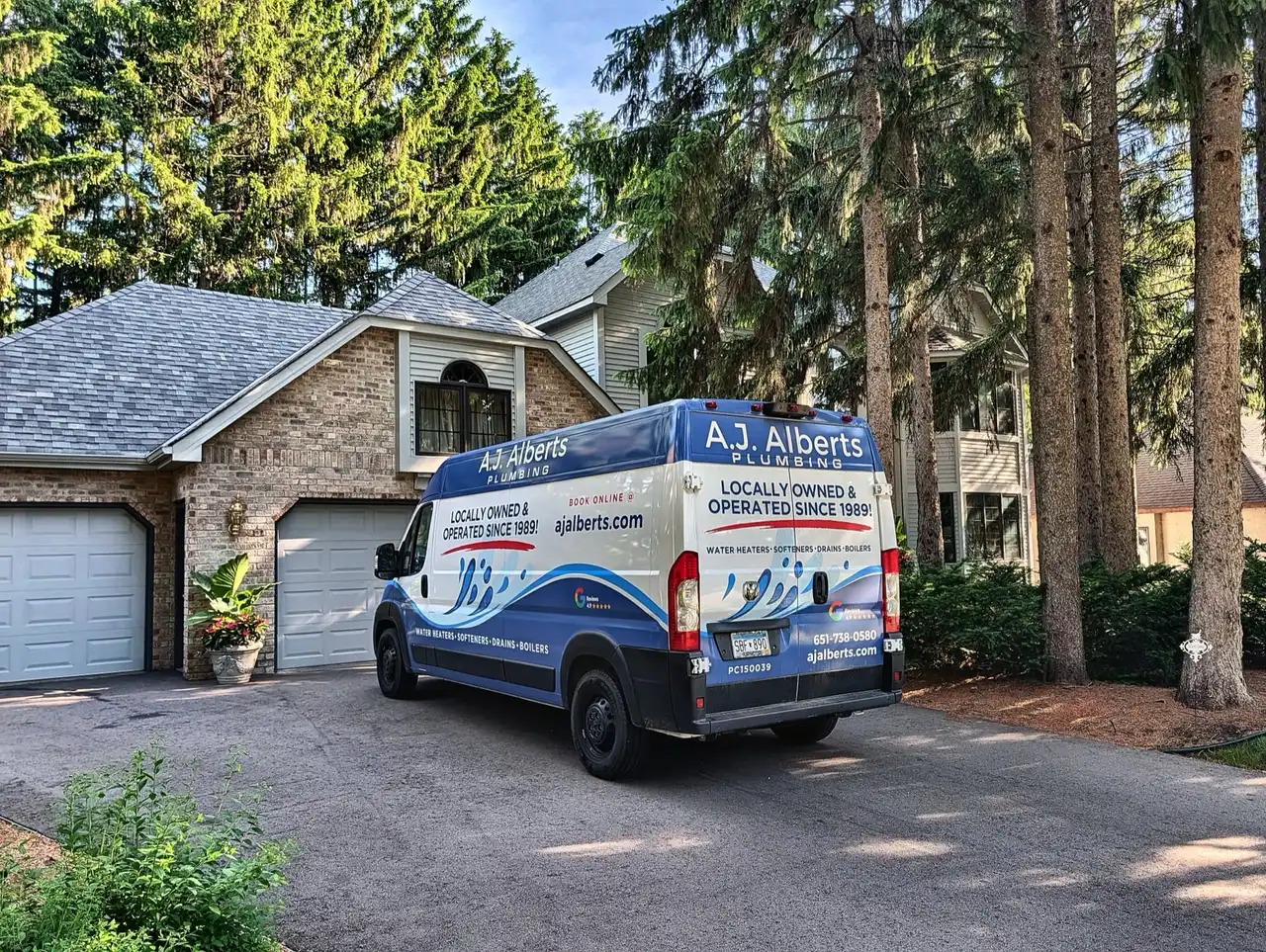
A.J. Alberts Plumbing service van at a Twin Cities home, locally owned and operated since 1989

Water Heaters

Water Heater Replacement vs Repair: Twin Cities Decision Guide

Should you repair or replace your Twin Cities water heater? A clear decision framework based on age, cost, water quality, and safety. Call 651-738-0580.

Call 651-738-0580
Water Heater Replacement vs Repair: Twin Cities Decision Guide

A failing water heater rarely fails on a convenient day. It fails on the coldest morning in January, the night before guests arrive, or three hours into a Sunday when nothing is open. By the time most East Metro homeowners call us, the decision is already urgent and emotional, which is the worst combination for spending money well.

The repair versus replace question has a clean answer once you stop guessing and start measuring. Age, condition, water quality, repair cost, and what the unit is actually doing to your monthly utility bill tell the full story. This guide walks you through the same decision framework our technicians use when we open a basement door in Woodbury, Stillwater, Cottage Grove, Lake Elmo, Hugo, or anywhere else across the East Metro and St. Croix Valley.

By the end, you will know whether to spend a few hundred dollars and move on with your life, or whether a replacement is the smarter long-term play.

Why Twin Cities Water Heaters Fail Sooner Than They Should

The average residential water heater is rated for 8 to 12 years. In the East Metro, we routinely see units fail at 6 to 9 years, and the reason is sitting in your basement right next to the tank.

Twin Cities municipal and well water is hard. Washington County, eastern Ramsey County, and northern Dakota County all see calcium and magnesium concentrations that quietly destroy water heater tanks. Hard water minerals settle at the bottom of the tank, bake onto the heating element or burner area, and create an insulating layer of scale. That scale forces the unit to work harder, run longer, and overheat the bottom of the tank. Over time, the tank lining cracks, the anode rod gets consumed early, and the steel starts to rust from the inside out.

If you have never tested your water and you have never had a water softener serviced or installed, your water heater has been fighting a losing battle since the day it was hooked up.

This is why the conversation about repair or replace cannot be separated from the conversation about water quality. We will come back to that.

The Five Signals That You Need a Decision Right Now

Before we get into the framework, here are the failure signs that should prompt the conversation in the first place. If you see any of these, you are not overreacting by calling a plumber.

Discolored water coming out of the hot side, especially rust or brown tint, almost always means tank corrosion. That is not repairable.

A rumbling, popping, or knocking sound from the tank means sediment buildup is severe. Sometimes this can be flushed. Often it is too late.

Pooled water around the base of the tank is a tank leak until proven otherwise. This is not a wait and see situation. A slow leak becomes a basement flood without warning.

Hot water that runs out faster than it used to, or never gets hot enough, points to a failing heating element, a thermostat issue, or sediment crowding the burn chamber. Sometimes this is a simple repair. Sometimes it is the tank telling you it is done.

Unusually high gas or electric bills with no other explanation often trace back to a water heater that has lost efficiency. A unit running 30 to 40 percent below its original efficiency is costing you real money every month.

If any of these are happening, get a professional inspection before you decide anything. A 20 minute diagnostic visit beats a guess every time.

The Decision Framework: Repair vs Replace

Here is the rule we use, and we apply it consistently across every East Metro home we service.

Rule One: The Age Test

If your water heater is under 8 years old and the repair is straightforward, repair it. Thermostats, heating elements, gas valves, thermocouples, anode rods, and pressure relief valves are all repairable components. A unit in the first half of its life is worth keeping in service.

If your water heater is 10 years old or older, lean replacement. Even if the current problem is fixable, you are paying for a repair that buys you 6 to 18 months at most. The next failure is coming, and it might be the tank itself.

If your water heater is in the 8 to 10 year window, the rest of the framework decides.

Rule Two: The 50 Percent Rule

Add up the cost of the repair, including parts and labor. If that number is more than 50 percent of the cost of a new water heater installed, replace it.

For example, if a quality 50 gallon gas water heater installation in the East Metro runs around 2,200 to 2,800 dollars depending on venting, code upgrades, and expansion tank requirements, and your repair quote is 1,400 dollars, you are pouring money into a unit that is about to need more work anyway. Replace it.

If the repair is 300 dollars on the same unit, fix it and move on.

Rule Three: The Tank Test

This is the one rule that overrides everything else. If the tank itself is compromised, you replace it. There is no scenario where a leaking, rusting, or structurally cracked tank is worth repairing. Tanks are not field repairable. The moment the tank fails, the unit is done.

A leak from a fitting, valve, or connection is repairable. A leak from the tank body is not.

Rule Four: The Efficiency and Capacity Test

Even if the current unit is repairable, ask yourself two questions.

Is it the right size for your household today? Twin Cities families add bathrooms, install soaking tubs, and convert basements into living space. A 40 gallon unit that worked for a young family might be undersized now.

Is it costing you in monthly bills? Older atmospheric vented gas units run at 55 to 65 percent efficiency. Modern condensing or high efficiency units run 90 percent or higher. Tankless units only heat on demand. If your annual operating cost is 25 to 40 percent higher than it should be, replacement pays for itself.

What Twin Cities Homeowners Actually Spend

Pricing varies based on fuel type, capacity, venting, code requirements, and water quality factors. Here is a realistic range for the East Metro in 2026.

Standard 40 to 50 gallon gas water heater, installed: approximately 1,800 to 2,800 dollars.

Standard 40 to 50 gallon electric water heater, installed: approximately 1,500 to 2,400 dollars.

High efficiency power vent or direct vent gas: approximately 2,800 to 4,200 dollars.

Tankless gas water heater, installed: approximately 4,500 to 7,500 dollars depending on venting and gas line sizing.

Common repairs, parts and labor: 200 to 900 dollars depending on the component.

These ranges assume permitted work, code compliant venting, an expansion tank where required, and a licensed plumber doing the install. Any quote significantly below these ranges should raise questions about what is being skipped.

Tank vs Tankless: Is It Worth the Switch in Minnesota?

Tankless water heaters are popular in the marketing world but require a real conversation in the Minnesota climate.

The case for tankless is genuine. Endless hot water, smaller footprint, longer lifespan, and lower operating cost for households that use moderate amounts of hot water spread throughout the day.

The case against tankless in the East Metro is also real. Twin Cities groundwater enters the home very cold for much of the year, sometimes in the high 30s during winter months. That extreme delta between incoming water temperature and target temperature means tankless units need significant BTU capacity, properly sized gas lines, and correct venting. Hard water makes the heat exchanger scale up fast without proper water treatment, which is why every tankless install we do includes a water quality conversation.

Tankless is the right call when the home has high concurrent demand, the homeowner plans to stay long term, and the water is already treated or will be. It is the wrong call when the install is being driven by marketing rather than need.

For most Twin Cities households, a properly sized, high efficiency tank unit paired with treated water is the lowest cost, highest reliability path.

The Water Quality Conversation Most Homeowners Skip

If you replace a water heater without addressing the water that destroyed the old one, you have just bought a 12 year unit that will fail in 7.

Every water heater installation we do at A.J. Alberts includes a water quality discussion because we have replaced too many premature failures to pretend it does not matter. Hard water shortens water heater life by 30 to 50 percent. Iron and manganese cause staining and accelerate corrosion. Chlorine attacks rubber components and gaskets.

Before you spend 2,500 dollars on a new water heater, spend 30 minutes on a free water test. If your water is hard or has elevated iron, a properly sized water softener or whole home conditioning system protects your investment and pays itself back through extended water heater life, lower energy bills, and reduced maintenance.

This is not an upsell. It is basic system thinking. You do not buy a new engine for a car without changing the oil.

When to Call A.J. Alberts vs When to Wait

Call us immediately if you see water around the base of the tank, smell gas, see rust in your hot water, or have no hot water at all and a unit older than 7 years.

You can wait a day or two if hot water capacity is reduced but functional, the unit makes new noises but is not leaking, or you are seeing higher bills but no other symptoms. Those are diagnostic visits, not emergencies.

The conversation we have when we walk into a basement is the same every time. We measure water quality, check the age and condition of the unit, inspect the venting and code compliance, and give you the actual numbers. You decide. We do not pressure replacements when repairs make sense, and we do not waste money on repairs when the unit is past saving.

Sources and Further Reading

The Bottom Line

The water heater decision is rarely about the water heater. It is about age, water quality, repair cost relative to replacement, and what the unit is doing to your monthly bills. Run it through the framework above and the answer becomes obvious.

If your unit is under 8 years old and the repair is reasonable, fix it. If it is over 10, replace it. If the tank itself has failed, replace it without hesitation. And whatever you decide, do not put a new water heater into untreated water and expect it to last. The unit is only as durable as the water that flows through it.

Call 651-738-0580 to schedule a free water test, or visit our water heater services page to learn more.

Frequently Asked Questions

How long should a water heater last in the Twin Cities?
A standard tank water heater is rated for 8 to 12 years, but in the East Metro we typically see real world lifespans of 6 to 10 years due to hard water. With a properly maintained water softener and annual flushing, you can reach the upper end of that range or beyond. Tankless units can last 15 to 20 years with proper water treatment.
Is it worth repairing a water heater older than 10 years?
Usually not. Even if the repair is straightforward, you are extending the life of a unit that is statistically near the end. Exceptions exist, especially if the unit has been on softened water its entire life and is in excellent shape, but a 10 year plus unit needing a major repair is almost always a replacement conversation.
How do I know if my water heater is failing because of hard water?
Telltale signs include a rumbling or popping sound from the tank, sediment in hot water lines, reduced hot water capacity over time, and a unit that fails years earlier than it should. A free water test confirms it. If your hardness is above 7 grains per gallon and you have no softener, hard water is almost certainly part of the problem.
Should I switch to tankless when my current unit fails?
Sometimes. Tankless makes sense when the home has high concurrent hot water demand, the gas line and venting can support it, the water is or will be properly treated, and you plan to stay in the home long term. For many Twin Cities households, a high efficiency tank unit is the better value.
Do I need a permit to replace a water heater in the East Metro?
Yes. Water heater installations in Washington County, Ramsey County, and Dakota County require permits and licensed plumber installation. Code requires proper venting, expansion tanks where applicable, seismic strapping in some jurisdictions, and a final inspection. Any contractor who skips the permit is skipping the inspection that protects you.
How often should I flush my water heater?
Once a year for homes on softened water. Twice a year for homes on hard or untreated water. Annual flushing removes sediment, extends the life of the tank, and maintains efficiency. It also gives you an early look at the condition of the anode rod and the inside of the tank.

Need Help in the Twin Cities?

Free in-home water test. Written upfront pricing. Lifetime craftsmanship warranty.