Water Heaters
Water Heater Capacity for Holiday Guests in Minnesota Homes
Plan hot-water demand for holiday guests in your Twin Cities home, check actual capacity, and know when a weak heater needs service. Call 651-738-0580.
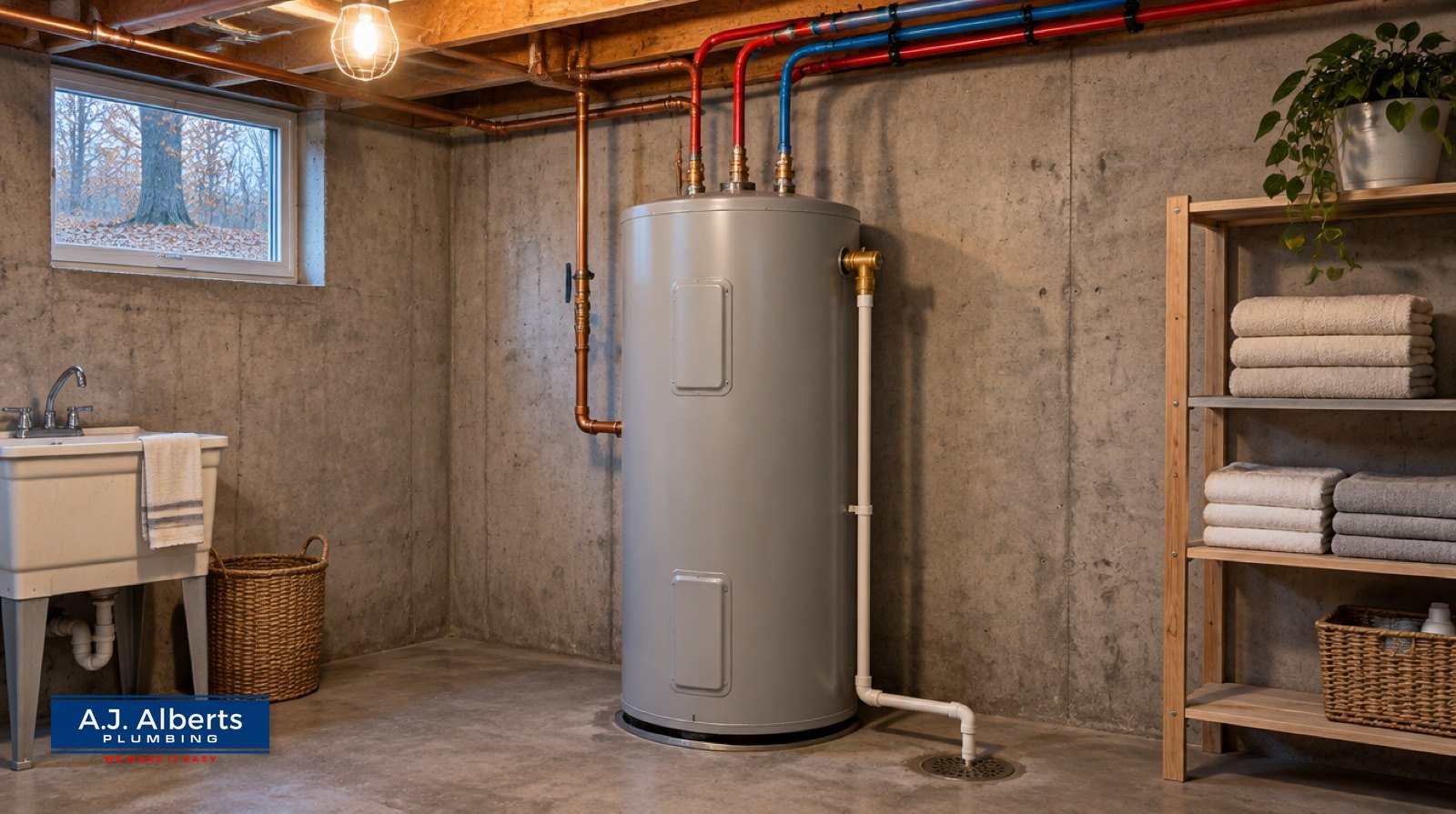
A water heater can handle holiday guests when its usable hot-water delivery matches the home's busiest hour, not merely the number printed on the tank. Check the unit for leaks or faults, find its first-hour or flow rating, estimate overlapping showers and appliance use, and test that schedule before guests arrive. Stagger demand instead of turning up the temperature.
Published November 11, 2026 by Steve Grohn, owner of A.J. Alberts.
Holiday hosting can turn a normal morning into several showers, a dishwasher cycle, food preparation, and laundry within the same hour. This guide is for Twin Cities homeowners expecting overnight guests in Woodbury, Oakdale, Stillwater, Cottage Grove, Edina, or nearby communities.
The goal is not to promise an exact number of showers from a tank size. Hot-water delivery depends on the heater type, model, fuel or electrical input, incoming-water temperature, fixture flow, current condition, and how closely the uses overlap. A practical plan uses the equipment label and household schedule, then leaves room for recovery.
What actually determines water-heater capacity?
For a storage water heater, tank volume is only part of the answer. The more useful comparison is first-hour rating, often shortened to FHR. ENERGY STAR defines FHR as the estimated maximum gallons a fully heated storage water heater can supply during the following hour. It combines stored hot water with the water the unit can heat while that hour is underway. This standardized rating is an estimate, not a guarantee of a particular number of showers under every household temperature or operating mode.
For a tankless heater, the important figures are flow rate and temperature rise. A model may provide a higher flow when the incoming water is warmer and a lower flow when it must create a larger temperature rise. That is why a tankless label or specification sheet should be read with the home’s winter conditions and simultaneous fixtures in mind.
Use this comparison before assuming the existing heater is too small:
| System | Rating to find | Holiday question | Common planning mistake |
|---|---|---|---|
| Storage tank | First-hour rating, not tank gallons alone | Does the rating cover the busiest hour, with recovery time between clusters? | Assuming every 50-gallon heater delivers the same amount in an hour |
| Heat pump water heater | First-hour rating and available operating modes | Will the selected mode meet a short high-demand period without an unexpected efficiency tradeoff? | Changing modes without checking the model manual |
| Tankless | Gallons per minute at the required temperature rise | Can it support the fixtures likely to run at the same time in winter? | Using a maximum flow figure without its temperature-rise condition |
| Indirect or boiler-connected | Manufacturer delivery data for the complete system | How do space-heating demand, controls, and domestic hot-water priority interact? | Judging the tank without considering the boiler and controls |
If the label is unreadable, record the manufacturer and model number, then look for the current manual or specification sheet. Do not guess from the tank’s outside dimensions.
How do you estimate the busiest holiday hour?
Write down the hot-water uses that could overlap. You do not need a made-up national average. Use the flow information for your own showerheads and appliances when it is available, and use the actual cycle choices your household expects.
Create a simple peak-hour worksheet:
- Identify the hour with the most likely demand, often the morning shower window or the period after a large meal.
- List each shower, dishwasher cycle, laundry cycle, bath, and substantial sink use that may happen during that hour.
- Note which uses can move earlier or later without disrupting the gathering.
- Compare the remaining peak with the heater’s rated delivery and the manufacturer’s guidance.
- Test the planned sequence on an ordinary day before guests arrive.
The test matters because it reveals the difference between a scheduling problem and a performance problem. If the heater handles the separated schedule but not simultaneous use, demand management may be enough for the holiday. If normal household demand already produces lukewarm water, a long recovery, a fault code, or new noise, the system deserves diagnosis before more people arrive.
Our guide to water-heater types in Minnesota explains the operating differences among storage, tankless, heat pump, and indirect systems.
What is the safest way to make existing capacity go farther?
Move flexible loads away from the shower window. Run laundry earlier, start the dishwasher after showers, and ask overnight guests to leave recovery time between long showers. Fix dripping hot-water faucets, because they consume heated water even when no useful task is being completed.
Do not raise the thermostat as a shortcut. The U.S. Consumer Product Safety Commission urges users to lower residential water heaters to 120 degrees Fahrenheit to reduce tap-water scald injuries. Even water at that temperature can burn with prolonged exposure. The CDC notes that hotter storage can reduce germs such as Legionella but increases burn risk. Temperature and mixing decisions depend on the household and system; consult a qualified professional about safe settings and applicable requirements.
If your heat pump water heater has a high-demand or hybrid mode, read the manual before changing it. The available modes and their energy tradeoffs vary by model. Rheem describes its ProTerra modes as one example; consult your own model manual. Return the heater to the intended normal setting after the high-demand period if the manufacturer directs that approach.
Which warning signs need urgent action?
If you smell gas, leave immediately on foot. Do not operate switches, phones, or anything that could cause a spark while leaving. From a safe location, call 911 and your gas utility. Do not return or try to repair the leak. See CenterPoint Energy’s gas leak instructions.
If a carbon monoxide alarm sounds, leave for fresh air immediately and call 911 from outside. Do not reenter until emergency responders say it is safe.
Scorching, damaged venting or wiring, and a capped, blocked, or altered relief discharge line need prompt professional assessment. Stop using the heater and keep clear; do not touch damaged wiring or attempt repairs. Do not cap a relief line or add a shutoff between the relief valve and the heater. If there is an immediate danger, leave and call 911.
For non-emergency problems such as reduced hot water, a recurring fault code, new noise, discoloration, or a leak, arrange an assessment promptly. Avoid water near electrical equipment. See our water-heater service guide.
Does hard water matter during holiday hosting?
Hard water is not a one-week emergency, but it belongs in long-term water-heater care. The U.S. Geological Survey explains that heating hard water can form calcium carbonate deposits. Scale can reduce equipment life, raise water-heating costs, lower electric water-heater efficiency, and restrict piping.
That does not mean visible scale proves the heater is undersized or failing. A basic hardness result also does not identify a bad element, burner problem, failed control, dip-tube issue, or tankless flow restriction. Equipment diagnosis and water-treatment planning are related but separate jobs.
A.J. Alberts’ free basic in-home water test can measure hardness and other treatment-planning factors. It does not test for every regulated contaminant or establish overall drinking-water safety. Use the result with the heater manufacturer’s maintenance instructions rather than assuming one maintenance interval fits every model and household.
A practical 48-hour plan before guests arrive
Two days before arrival
Find the model number and rating information. Check the floor, connections, venting, discharge pipe, and control display without opening sealed or energized compartments. Review the manual for normal modes and any approved diagnostic steps.
One day before arrival
Run the expected peak schedule with normal thermostat settings. Record when showers, dishwashing, and laundry occur, when the temperature starts to fall, and how long recovery takes. If the test reveals a leak, fault, discolored water, or failure under ordinary demand, arrange service rather than repeating the stress test.
During the visit
Post a simple shower order, move laundry out of the morning window, and run the dishwasher after the busiest bathroom period. The related Thanksgiving plumbing preparation guide covers drains, disposals, toilets, and backup response as well as hot water.
Related reading for holiday hosts
- Types of Water Heaters for Minnesota Homes
- Thanksgiving Plumbing Prep Guide
- Slow Hot Water Troubleshooting
Sources and Further Reading
- ENERGY STAR, Residential Water Heater Key Product Criteria, accessed November 11, 2026
- U.S. Consumer Product Safety Commission, Avoiding Tap Water Scalds, accessed November 11, 2026
- U.S. Geological Survey, Hardness of Water, accessed November 11, 2026
The Bottom Line: Plan the Peak, Then Check the Equipment
Holiday hot-water capacity is a delivery question, not a tank-size guess. Identify the actual model, use first-hour rating or flow at the required temperature rise, map the busiest hour, and move flexible loads away from showers. Test the plan while there is still time to respond to a problem.
Scheduling can help a healthy system. It cannot make a leak safe, correct damaged venting, restore a failed component, or prove that the current heater is sized correctly. When normal demand already exceeds delivery or warning signs are present, get the equipment diagnosed before the guest count rises.
Steve Grohn, owner of A.J. Alberts, has served Twin Cities homeowners through the Woodbury-based plumbing and water-conditioning company since 1996. A.J. Alberts is locally owned and operated, and recommendations are made without commissioned salespeople.
Need help checking water-heater condition or capacity before holiday guests arrive? Call A.J. Alberts at 651-738-0580. Minnesota plumbing license PC150039.
Frequently Asked Questions
How can I tell whether my water heater will keep up with holiday guests?
Should I turn up the water heater before guests arrive?
Why does my hot water run out faster in winter?
Can I solve a holiday hot-water shortage by installing a larger tank?
Does hard water reduce water-heater capacity?
Related services
Need Help in the Twin Cities?
Free in-home water test. Written upfront pricing. Lifetime craftsmanship warranty.