Water Conditioning
How to Read Your Annual Water Quality Report in Minnesota
Learn how to read a Minnesota water quality report, compare detected levels with limits, and know when household testing adds context. Call 651-738-0580.
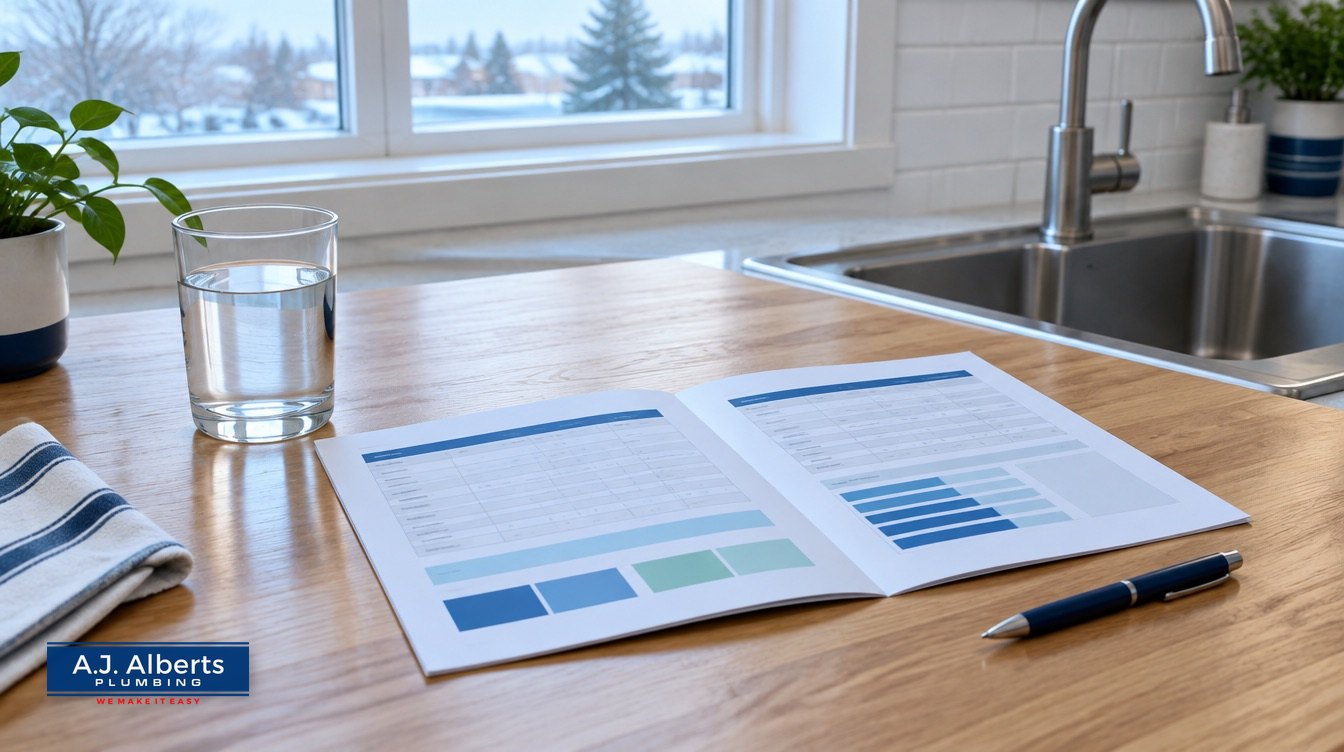
To read an annual water quality report, first confirm the water supplier and reporting year. Then identify the source water, scan for violations, and read each detected result beside its unit, sample date, range, regulatory limit, and likely source. The report describes the public water system. It does not automatically measure the water at one kitchen tap or diagnose a home's plumbing.
Published October 21, 2026 by Steve Grohn, owner of A.J. Alberts.
Minnesota community water systems publish annual water quality reports, also called Consumer Confidence Reports or CCRs. The Minnesota Department of Health says these reports tell customers where their drinking water comes from, what was found, and how people can help protect the supply. Reports are generally published by July for monitoring from the previous calendar year.
That timing is easy to misread. The City of Woodbury’s current report was published in 2026 and covers monitoring completed from January 1 through December 31, 2025. The publication year, monitoring year, and individual sample date can all be different, so keep all three in view.
What should you check first in a water quality report?
Start with a six-step reading order. It keeps an unfamiliar table from turning into either false reassurance or unnecessary alarm.
| Step | What to find | Why it matters |
|---|---|---|
| 1. Confirm the system | Utility name, public water system ID, and report year | A nearby city or private well can have a different source and monitoring record. |
| 2. Identify the source | Groundwater wells, a river, a lake, or a purchased supply | The source section explains where the utility begins and which protections apply. |
| 3. Scan the summary | Violation statements, notices, and required health information | A clear compliance issue should not be buried beneath individual numbers. |
| 4. Read across the table | Substance, goal, limit, result, range, date, violation status, and typical source | No single cell tells the whole story. |
| 5. Check the units | ppm, ppb, ppt, pCi/L, or another defined unit | A number has no useful meaning without its unit and comparison value. |
| 6. Define your household question | Utility compliance, taste, hardness, lead from plumbing, PFAS, or another concern | Different questions require different evidence and sometimes different tests. |
Minnesota residents can use the MDH Consumer Confidence Report search or their utility’s website to find the current report. Renters who do not receive a water bill can ask the building manager or utility. Private wells do not receive a CCR because they are not community water systems.
What do MCL, MCLG, AL, TT, and MRDL mean?
The abbreviations look technical, but each one answers a specific question. EPA’s water quality report guide provides the basic definitions.
| Term | Plain-language meaning | How to use it |
|---|---|---|
| MCL | Maximum Contaminant Level, the highest level allowed in drinking water | Compare the reported result with this enforceable limit when the table uses an MCL. |
| MCLG | Maximum Contaminant Level Goal, the level below which no known or expected health risk is identified | Treat it as a health goal with a margin of safety, not as the enforceable limit. |
| AL | Action Level, a concentration that triggers required system actions when exceeded | Look for the system's reported value, the action level, and whether an exceedance occurred. |
| TT | Treatment Technique, a required process used instead of a numeric MCL | Check whether the system met the required treatment process. |
| MRDL | Maximum Residual Disinfectant Level, the highest allowed level of a disinfectant | Read it with the reported disinfectant result and the corresponding goal. |
| MRDLG | Maximum Residual Disinfectant Level Goal | Use it as the health goal while remembering that disinfectants also control microbes. |
MCL and MCLG are not interchangeable. The goal is health based. The enforceable limit accounts for what can be achieved with available treatment and monitoring. An action level is different again: crossing it triggers required actions rather than functioning as a simple household pass or fail number.
How do you read one row of the detected contaminant table?
Read from left to right and resist stopping at the contaminant name. A practical sequence is:
- Name: Identify the substance or measurement.
- Unit: Confirm whether the result is in parts per million, parts per billion, parts per trillion, or another unit.
- Regulatory comparison: Find the MCL, action level, treatment technique, or disinfectant limit used for that row.
- Reported result: Note whether the table gives a highest level, average, 90th percentile, or another statistic.
- Range: Check the lowest and highest detected values when a range is provided.
- Sample date: Confirm when the monitoring occurred.
- Violation: Read the report’s compliance conclusion.
- Typical source: Use the source description as context, not as proof of the source in one home.
The word detected does not by itself mean unsafe. Public laboratories can measure very small amounts. The meaningful comparison is the result, in the correct unit, against the standard or action level used in that row.
The word none also needs care. A table may omit substances that were tested for but not found. If the report uses ND, read its own definition. It often refers to no detection at the reporting or analytical level, not a promise that the substance is absent at every possible concentration.
Why can the sample date be older than the report year?
Not every contaminant is sampled every year. Woodbury’s 2025 report explains that some contaminants are monitored less often because their levels are not expected to change from year to year. If a substance was found during the most recent required sampling, the utility may include that result and its actual detection date in a later report.
That is why the date column matters. An older date is not automatically an error, but it should not be presented as a new sample. If the timing is unclear, contact the utility and ask when that contaminant was last sampled, whether the result represents source water or finished water, and what part of the system the sample represents.
What does the lead and copper 90th percentile tell you?
Lead and copper rows often use a 90th percentile result rather than a simple systemwide average. EPA explains that the value is compared with the applicable action level to determine whether the public water system must take additional action.
That statistic does not tell you the result at a specific address. Lead can enter drinking water through service lines, fixtures, solder, and other plumbing materials. A compliant system result and a concern about one home’s plumbing can both be true at the same time.
If you are concerned about lead at your tap, follow current utility and MDH sampling instructions and use an accredited laboratory. An in-home hardness or total dissolved solids reading cannot substitute for a lead analysis.
What does a CCR tell you about your own home?
A CCR is the right starting point for municipal source and system information. It is not a complete household water test. Water can change after it enters the service line and building plumbing, and a utility table may combine samples taken at different locations or times.
Use the report to form a narrower question:
- Hardness or scale: Check the utility’s published hardness guidance, then measure at the home before sizing treatment.
- Lead from plumbing: Review the service line information and arrange appropriate tap sampling if needed.
- PFAS: Separate source-well information from finished water and household tap results. A conventional softener is not PFAS treatment.
- Taste or odor: Ask whether the concern affects hot water, cold water, one fixture, or the whole home before choosing a test.
- Private well: Use testing guidance specific to the well and local conditions, not a nearby city’s CCR.
AJ Alberts’ water quality resource organizes local utility references and testing context. A free basic in-home water test checks hardness, iron, chlorine, pH, total dissolved solids, and alkalinity, plus nitrate for private-well customers. It does not measure PFAS, lead, every regulated contaminant, or overall drinking-water safety. Separate laboratory testing is appropriate for questions outside that scope.
When should you call the utility, a laboratory, or a plumber?
Call the water utility when you need the current report, sample location, monitoring schedule, treatment explanation, service line record, or clarification of a violation or notice. The utility is the primary source for what its report says.
Use an MDH-accredited laboratory when the question requires a household sample for lead, PFAS, bacteria, nitrate, or another specific analyte. Follow the laboratory’s container, collection, preservation, and delivery instructions. A sample collected in the wrong container may not answer the question.
Call a licensed plumber or water-conditioning professional when the question involves the service line, household piping, cross connections, treatment equipment, pressure, recurring staining, scale, taste, or odor. Treatment should follow a defined problem and a model-specific performance claim. Our water filtration page explains why equipment selection starts with the contaminant and the exact certified reduction claim.
For health advice, contact a healthcare provider or public-health agency. A contractor should not turn a CCR into a medical diagnosis.
Related reading for Twin Cities homeowners
- Woodbury Drinking Water Reports: How to Read PFAS Results
- What We Check in a Free In-Home Water Test
Sources and Further Reading
- EPA, Understanding Your Water Quality Report
- EPA, lead and copper 90th percentile in a water report
- Minnesota Department of Health, Consumer Confidence Reports
- City of Woodbury, 2025 Drinking Water Quality Report
The Bottom Line: Read the Whole Row, Then Define the Home Question
Your annual water quality report is a system-level record, not a product recommendation. Confirm the correct utility and year, identify the source, scan the compliance summary, and read each detected value with its unit, date, range, comparison standard, and violation status. A detected amount below a limit is different from a violation, and a current report can legitimately include an older sample date when monitoring occurs less often.
Then decide what you still need to know about the home. Utility compliance, plumbing materials, hardness, PFAS, lead, taste, and odor are different questions. The next step may be a call to the utility, a properly collected laboratory sample, a basic in-home measurement, or no equipment change at all.
Steve Grohn, owner of A.J. Alberts, has served Twin Cities homeowners through the Woodbury-based plumbing and water-conditioning company since 1996. A.J. Alberts is locally owned and operated, and recommendations are made without commissioned salespeople.
Want help separating a city report from a household water concern? Call A.J. Alberts at 651-738-0580.
Frequently Asked Questions
What does no violation mean on a water quality report?
Does detected mean my drinking water is unsafe?
Why does a current report show an older sample date?
Does a consumer confidence report cover a private well?
Can a water softener address every substance listed in a CCR?
Related services
Need Help in the Twin Cities?
Free in-home water test. Written upfront pricing. Lifetime craftsmanship warranty.