
Plumbing
Winterize Outdoor Faucets Before the First Freeze in Minnesota
Winterize outdoor faucets and hose bibs before Twin Cities cold arrives. Follow a Minnesota checklist that helps prevent freeze damage. Call 651-738-0580.
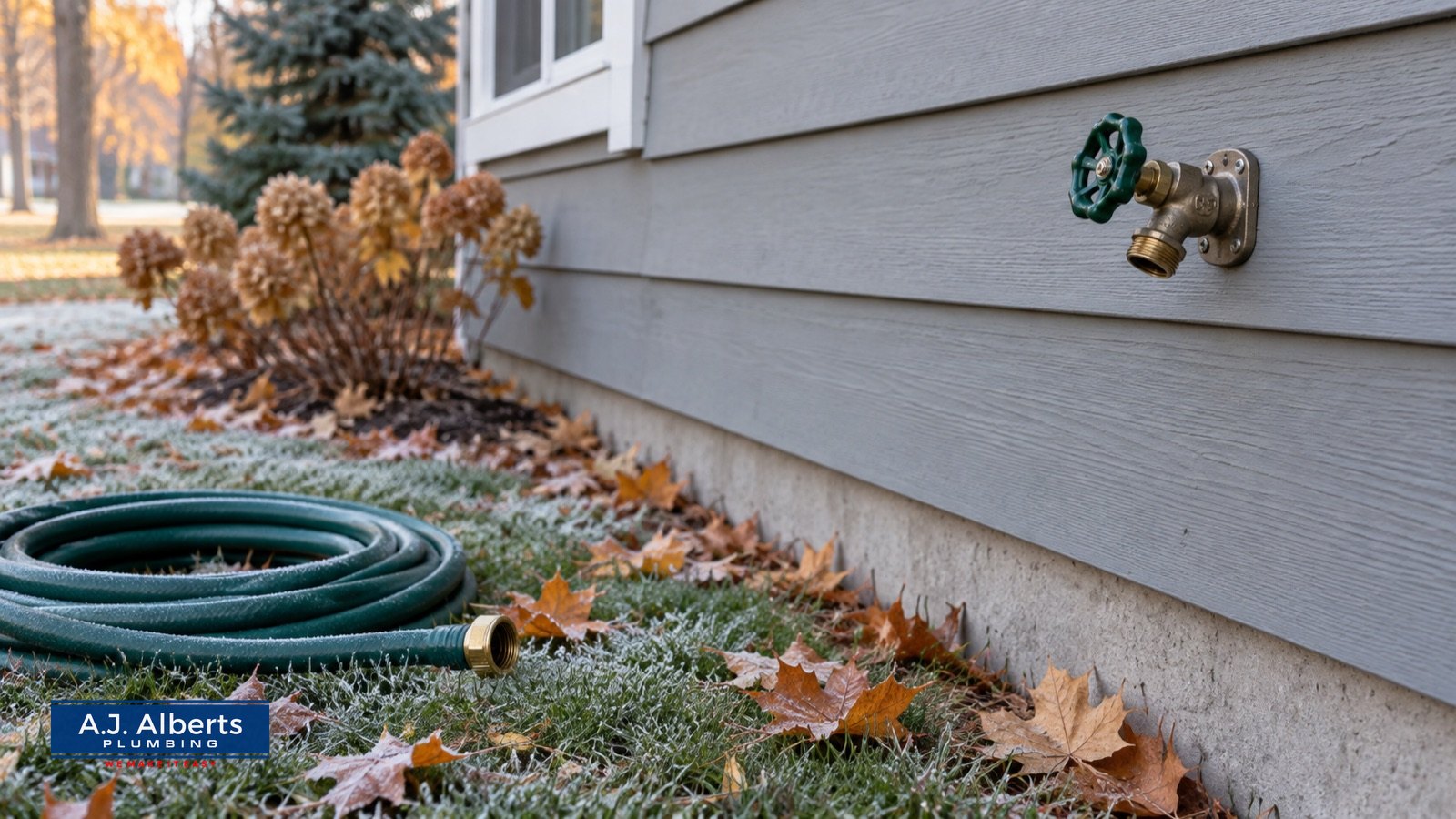
Winterize outdoor faucets before the first night at or below 32 degrees. Disconnect every hose and attachment, close the interior shutoff if your plumbing has one, open the outdoor faucet to drain the line, and leave the hose disconnected until spring. A frost-free faucet still needs to drain, so leaving a hose attached can defeat its protection.
In the Twin Cities, this job belongs on the early October list. The National Weather Service says the normal first fall freeze window for the Twin Cities is October 1 through October 10. That is a climate normal, not a promise about one particular night, but it explains why waiting for a hard freeze is the wrong approach.
Homes in Woodbury, Stillwater, Cottage Grove, Lake Elmo, Oakdale, Maplewood, Afton, and nearby western Wisconsin can have very different outdoor plumbing. Some have a basic hose bib with an interior shutoff. Others have a long frost-free sillcock that closes inside the heated part of the house. Many have splitters, timers, vacuum breakers, or irrigation connections attached. The right winterizing sequence starts by identifying what is actually installed.
What should you do before the first freeze?
Start with every outdoor water connection, not only the faucet you use most often. Walk around the house, detached garage, workshop, and any finished addition. A hidden side-yard faucet is easy to miss until it leaks inside a wall.
Use this checklist:
- Disconnect the garden hose, Y-splitter, timer, nozzle, pressure washer, and any other attachment.
- Drain the hose completely, coil it, and store it where trapped water cannot freeze inside the fittings.
- Find the indoor shutoff valve that serves the outdoor faucet, if one exists.
- Close that indoor valve fully.
- Open the outdoor faucet and let the remaining water drain.
- If the indoor shutoff has a bleeder cap, use it according to the valve and plumbing configuration so the trapped section can drain. Keep a container and towel ready.
- Leave the hose off for the winter. Follow the manufacturer guidance for whether the faucet itself should remain open or closed after draining.
- Add an insulated faucet cover if the location is exposed or the assembly needs extra protection. Treat the cover as backup, not as the whole winterization plan.
The EPA specifically recommends shutting off and draining outdoor spigots before freezing temperatures arrive. That simple sequence removes the water that can freeze inside the outdoor section of the plumbing.
Does a frost-free hose bib still need winterizing?
Yes. “Frost-free” describes the design, not a guarantee against every installation or use problem.
A frost-free sillcock places its shutoff point deeper inside the building, where temperatures should stay warmer. When installed with the proper slight downward pitch, the barrel can drain after the handle is closed. The U.S. Department of Energy’s Building America guidance calls for that slight downward slope and also recommends accessible indoor shutoffs, bleeder caps, and insulating covers in freezing climates.
The trouble starts when water cannot leave. A hose or attachment can hold water at the outlet. A faucet pitched back toward the house can retain water in the barrel. A wall cavity with air leaks can expose the plumbing to colder air than expected. Even a good fixture can fail when those conditions line up.
| Feature | Standard hose bib | Frost-free sillcock |
|---|---|---|
| Shutoff point | Near the exterior handle | Deeper inside the building |
| Drainage | Usually depends on an indoor shutoff and manual draining | Designed to drain when installed and used correctly |
| Hose left attached | Can trap water and increase freeze risk | Can block drainage and defeat the frost-free design |
| Best fall step | Shut off, disconnect, and drain | Disconnect attachments and confirm it can drain |
| When to call a plumber | No shutoff, recurring leaks, or suspected damage | Poor pitch, loose mounting, leakage, or repeated freezing |
If you are unsure which type you have, do not rely on the handle shape alone. A licensed plumber can identify the assembly, locate the shutoff, and check whether the faucet is installed so it can drain.
What should you remove from the faucet?
Remove anything threaded onto the outlet. That includes a garden hose, quick-connect fitting, spray nozzle, Y-splitter, irrigation timer, pressure regulator, or decorative cap that prevents drainage.
The most common mistake is removing the hose but leaving a splitter or timer attached. From the faucet’s point of view, that can create the same problem. Water remains trapped between the closed valve and the attachment.
Inspect the hose washer and connection while everything is apart. Mineral deposits around the threads can make an attachment difficult to remove, but water hardness does not cause freezing. Freeze risk comes from water remaining in a cold section of plumbing. If scale is a separate concern inside the home, a free basic water test can measure hardness before anyone recommends treatment.
Should you use an insulated faucet cover?
An insulated cover is useful as an extra layer, particularly on a windy wall, an older faucet, or plumbing near an unheated garage or crawlspace. It slows heat loss around the fixture. It cannot drain a pipe, correct a bad slope, close a missing shutoff, or make a connected hose safe.
Think of the cover as the final step after the plumbing is drained. If the only winter preparation is snapping a foam cover over a water-filled hose bib, the vulnerable water is still there.
What if there is no interior shutoff valve?
Do not force the main water valve closed just to experiment. First identify whether the faucet is a frost-free design. If it is, disconnect all attachments and make sure the outlet is clear. If it is a standard hose bib with no dedicated indoor shutoff, ask a licensed plumber about the practical options for that installation.
An accessible shutoff gives you control when a faucet leaks or freezes. The Department of Energy guidance recommends accessible indoor shutoffs for outdoor faucets. Adding one may require opening a finished area or rerouting pipe, so it should be evaluated at the house rather than treated as a universal do-it-yourself project.
Our plumbing service team can inspect the faucet, its pitch, the interior piping, and the shutoff arrangement without assuming replacement is always necessary.
How do you know freeze damage has already happened?
A split often stays hidden until the faucet is opened or the line is pressurized. Watch for these signs:
- Water appears in the basement, crawlspace, ceiling, or wall near the faucet.
- The faucet produces little or no water when other fixtures work normally.
- The handle will not move normally.
- The fixture is loose, cracked, or visibly distorted.
- Water leaks from the stem, vacuum breaker, or wall penetration.
If water is entering the building, close the nearest working shutoff or the home’s main shutoff and call for help. Our emergency plumber page explains what counts as an urgent plumbing problem and what to do while service is on the way.
For broader cold-weather prevention, see the Minnesota frozen-pipe guide. For the spring inspection after winter, the outdoor spigot and summer plumbing guide explains how hidden damage can show up once water pressure returns.
Can you thaw a frozen outdoor faucet yourself?
Do not use a torch, open flame, or any method that can start a fire or overheat the pipe. The EPA advises thawing frozen pipes slowly with warm air from an electric hair dryer and shutting off water if a pipe bursts.
That advice still requires judgment. Do not use an electrical appliance near standing water. Do not heat a pipe you cannot inspect. Do not assume the frozen section is only at the visible faucet. If the pipe is inside a wall, if you cannot confirm the condition of the line, or if any leak appears, shut off the water and call a licensed plumber.
Is water quality part of outdoor-faucet winterization?
Not directly. Hard water can leave deposits on threads, valves, and fixtures, but it does not change the basic freeze-prevention steps. The priority is getting water out of the cold section of pipe.
That distinction matters. A stiff handle or visible scale may deserve inspection, but it is not proof that water treatment will solve a winterization problem. Measure the water first, inspect the actual faucet, and address each issue for what it is.
Sources and Further Reading
- National Weather Service Twin Cities first fall freeze information
- EPA winter weather and indoor air quality guidance
- U.S. Department of Energy Building America plumbing insulation guidance
The Bottom Line
The reliable fall routine is simple: disconnect every hose and attachment, close the dedicated indoor shutoff when one exists, drain the outdoor section, and add a cover only as extra protection. Do it in early October, before freezing weather tests the weakest connection.
AJ Alberts has served Woodbury and the surrounding East Metro since 1989. Our Minnesota plumbing license is PC150039. We provide a clear diagnosis and written options without commissioned salespeople.
Need an outdoor faucet inspected, winterized, or repaired? Call AJ Alberts at 651-738-0580. You can also schedule a free basic water test for a separate water-quality concern.
Frequently Asked Questions
When should I winterize outdoor faucets in the Twin Cities?
Do I need to disconnect a garden hose from a frost-free faucet?
Should I cover an outdoor faucet after draining it?
How can I tell whether my outdoor faucet froze and split?
Can I thaw a frozen outdoor faucet with a torch?
Related services
Need Help in the Twin Cities?
Free in-home water test. Written upfront pricing. Lifetime craftsmanship warranty.